Google’s latest Android security updates patch over 40 vulnerabilities, including CVE-2023-0266, a kernel flaw exploited as a zero-day by a spyware vendor.
The Android vulnerability CVE-2023-20963, reportedly exploited as a zero-day by a Chinese app against millions of devices, was added to CISA’s KEV catalog.
Pig Butchering, also known as Sha Zhu Pan and CryptoRom, is an ugly name for an ugly scam. It is not new. What is new is that apps perpetrating the scam can be downloaded from the official Apple and Android app stores – giving them greater apparent validity to targets.
The scam is a version of romance scam, where targets are befriended, lured in, persuaded to download a disguised malicious app, drawn into false cryptocurrency dealing, and defrauded. It’s a long game social engineering scam built on trust rather than fear, greed, or urgency.
It originated in China. When the Chinese authorities clamped down, the gangs decamped to places like Cambodia. Now, according to an analysis from Sophos, the gangs are well organized but as ugly as the scam. At the top of the hierarchy is the ‘head office’ which does supervision and money laundering.
The scam itself is subcontracted to affiliates, which have a front desk handling staffing, a tech team handling the technology involved, and a finance team looking after the money. Profits tend to be divided 60-40 – with 40% going to the head office.
At the bottom of the pile are the keyboarders who liaise with, and trick the targets. These are often victims themselves, sometimes foreigners lured into the process by the promise of earning money, and kept in the process by the threat of violence.
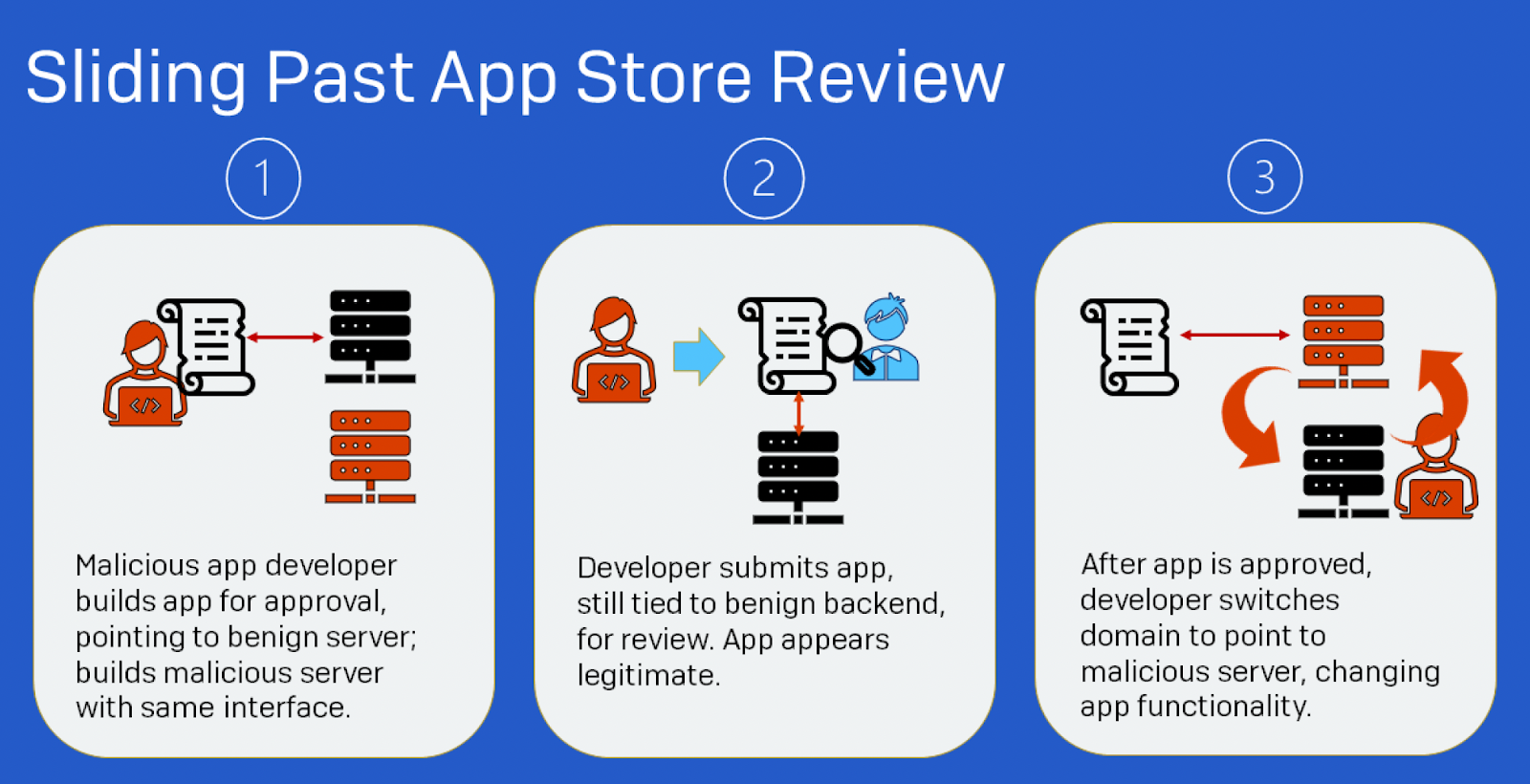
The new danger exposed by Sophos is not the scam (that’s not new) but the criminals’ success in getting malicious apps into the official app stores (Ace Pro and MBM_BitScan into the App Store, and BitScan into Google Play). This is not uncommon with Google Play, but unusual with Apple. In two separate examples that by-passed Apple’s App Store review, a legitimate-looking app initially communicates with a benign back end. Nothing malicious can be seen, so the apps passed Apple’s review.
Only after the app is accepted, downloaded, and launched does the developer switch domains, from the benign back end to a malicious server that delivers the malicious content.
How fraudulent applications likely evaded the Apple review process. (Image Credit: Sophos)
“When we originally began investigating CryptoRom scams targeting iOS users, the scammers would have to persuade users to first install a configuration profile before they could install the fake trading app,” comments Jagadeesh Chandraiah, senior threat researcher at Sophos. “This obviously involves an additional level of social engineering—a level that’s hard to surmount.”
Many potential victims would be ‘alerted’ that something wasn’t right if they cannot directly download a supposedly legitimate app. But by getting an application into the App Store, the scammers have vastly increased their potential victim pool, particularly since most users inherently trust Apple.
“Both apps are also unaffected by iOS’ new Lockdown mode, which prevents scammers from loading mobile profiles helpful for social engineering,” continued Chandraiah. “In fact, these CryptoRom scammers may be shifting their tactics – that is, focusing on bypassing the App Store review process – in light of the security features in Lockdown.”
The scam still requires extensive social engineering. The victim is typically approached via a dating app, and then invited to switch the conversation to WhatsApp. In one case, the victim was based in Switzerland. The scammer or scammers used a manufactured profile of a woman based in London, with a full and compelling Facebook profile complete with professional or stolen location and lifestyle photos.
“After establishing a rapport, the criminals behind the profile told the victim that ‘her’ uncle worked for a financial analysis firm, and invited the victim to do cryptocurrency trading together.” It was at this point that the victim was introduced to the fake application in the app store.
In such cases, a degree of patience is still demonstrated by the attackers. Crypto investment begins slowly, and the victim can even make withdrawals from the crypto account. But the investment goes straight to the criminals. By the time the victim realizes that something is wrong, both the money and the scammers are gone.
This scam, says the Sophos report, “is a well-organized, syndicated scam operation that uses a combination of romance-centered social engineering and fraudulent crypto trading applications and websites to lure victims and steal their money after gaining their confidence.” The worrying possibility for the future is that emerging artificial intelligence such as ChatGPT will make such detailed and professional social engineering even more compelling – and widely available to criminals less sophisticated.
Google Analytics è un servizio di analisi web fornito da Google Ireland Limited (“Google”). Google utilizza i dati personali raccolti per tracciare ed esaminare l’uso di questo sito web, compilare report sulle sue attività e condividerli con gli altri servizi sviluppati da Google. Google può utilizzare i tuoi dati personali per contestualizzare e personalizzare gli annunci del proprio network pubblicitario. Questa integrazione di Google Analytics rende anonimo il tuo indirizzo IP. I dati inviati vengono collezionati per gli scopi di personalizzazione dell'esperienza e il tracciamento statistico. Trovi maggiori informazioni alla pagina "Ulteriori informazioni sulla modalità di trattamento delle informazioni personali da parte di Google".
Cloudflare Web Analytics è un servizio di statistica anonimizzata fornito da Cloudflare Inc. che permette al Titolare di ottenere informazioni sull’utilizzo di questo sito web.
Google Maps è un servizio di visualizzazione di mappe gestito da Google Ireland Limited. Questo servizio serve ad integrare tali contenuti all’interno delle proprie pagine.
Gravatar è un servizio di visualizzazione di immagini gestito da Automattic Inc. che permette a Automattic Inc. di integrare tali contenuti all’interno delle proprie pagine.